
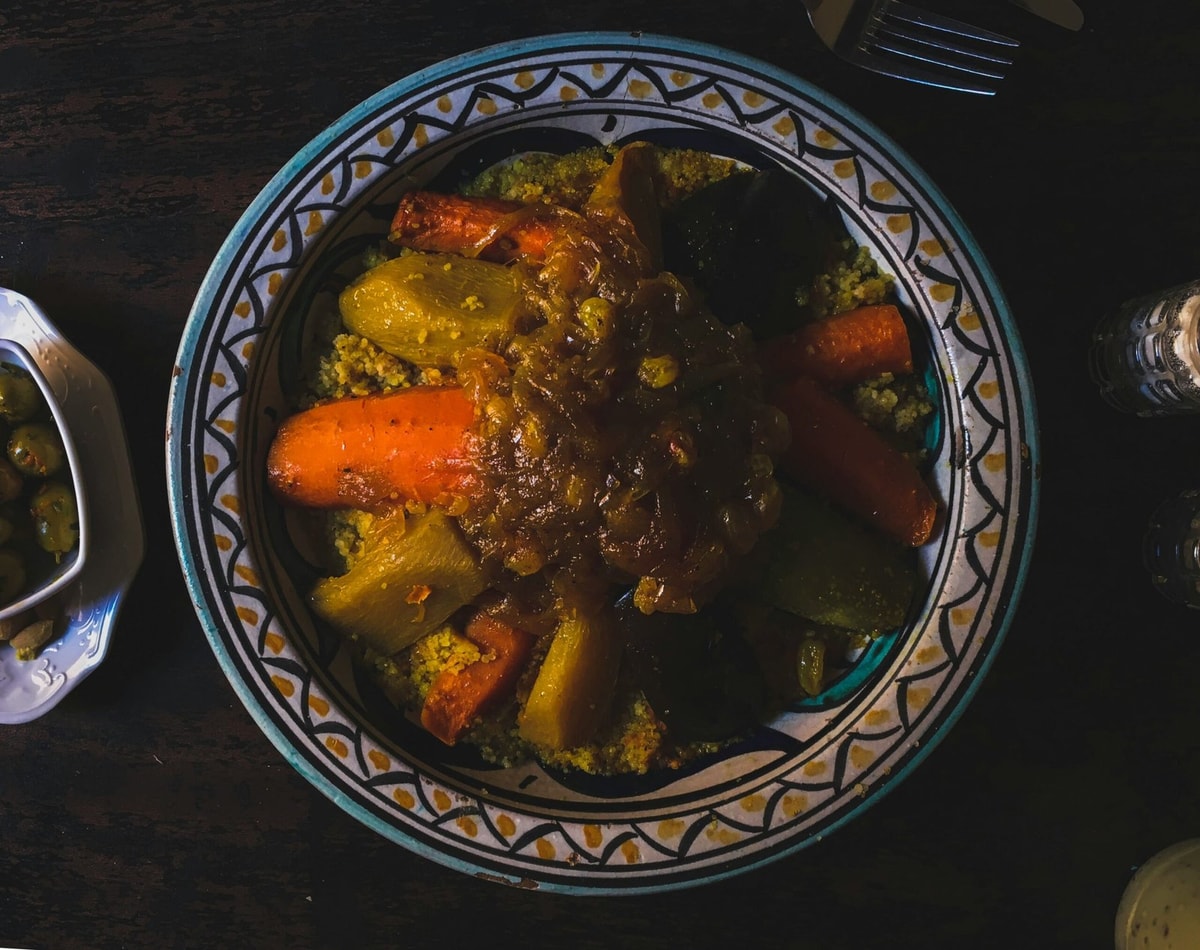
Which dishes are famous in Morocco? The best-known answers are tagine, couscous, pastilla, harira, rfissa and tanjia, but Moroccan food goes far beyond these famous names.
Food in Morocco changes from city to city and from one family to another. A meal in Marrakech may introduce you to slow-cooked tanjia, while northern Morocco has its own cheeses, olive products and Mediterranean influences. Coastal cities offer more fish and seafood, while mountain and inland regions have their own breads, soups and hearty dishes.
If you searched for a Moroccan dish cooked in a clay pot, you are probably thinking of tagine. The word refers both to the traditional cooking vessel and to the dish prepared inside it.
This guide introduces 15 of the most famous Moroccan food dishes, explains what they contain, where they come from and what travelers should know before ordering them.
Famous Moroccan Dishes at a Glance
| Dish | Main ingredients or style | Good to know |
|---|---|---|
| Tagine | Slow-cooked meat, fish or vegetables | Named after the clay cooking vessel |
| Couscous | Steamed semolina with vegetables and meat | Traditionally associated with Friday meals |
| Pastilla | Thin pastry with savory-sweet filling | Often chicken or seafood |
| Rfissa | Chicken, lentils and shredded flatbread | Rich family-style dish |
| Harira | Tomato, legumes, herbs and spices | Especially associated with Ramadan |
| Tanjia | Slow-cooked meat in an earthenware jar | Specialty of Marrakech |
| Mechoui | Slow-roasted lamb | Popular for celebrations and communal meals |
| Zaalouk | Cooked eggplant and tomato | Usually served as a salad or side |
| Taktouka | Peppers and tomatoes | Common Moroccan starter |
| Briouat | Small filled pastry | Can be savory or sweet |
| Seffa | Steamed vermicelli or couscous with sweet toppings | Sweet-savory combinations are common |
| Mrouzia | Lamb, raisins, honey and spices | Rich sweet-savory dish |
| Bissara | Fava bean or split-pea soup/purée | Simple and filling |
| Msemen & Baghrir | Moroccan pancakes and flatbreads | Common at breakfast or tea time |
| Chebakia | Fried sesame pastry with honey | Especially popular during Ramadan |
1. Tagine: Morocco’s Famous Clay-Pot Dish
If someone asks for a Moroccan dish cooked in a clay pot, tagine is the answer.
A tagine is actually two things: the traditional earthenware vessel and the food cooked inside it. The pot has a wide circular base and a distinctive conical lid.
Ingredients are traditionally cooked slowly, allowing meat and vegetables to become tender while spices, juices and aromatics combine into a concentrated sauce.
There is no single Moroccan tagine recipe. Different versions can appear throughout the country.
Chicken Tagine With Preserved Lemon and Olives
This is one of the most recognizable versions. Chicken is cooked with onion, herbs, spices, preserved lemon and green or purple olives.
The preserved lemon gives the dish a salty, citrus flavor that is very different from adding ordinary fresh lemon.
Lamb Tagine With Prunes
This version combines slow-cooked lamb with prunes, cinnamon and often almonds or sesame.
It is a good example of an important characteristic of Moroccan cuisine: the balance between savory and sweet flavors.
Vegetable Tagine
Vegetarian travelers will also find tagines made from combinations of potatoes, carrots, zucchini, tomatoes, peas and other seasonal vegetables.
Always ask whether meat stock has been used if you need a strictly vegetarian meal.
2. Couscous
Couscous is one of the most important Moroccan dishes and carries a strong social and cultural meaning.
The dish starts with small grains of semolina that are traditionally steamed rather than simply boiled.
They are then served with vegetables, broth and, depending on the recipe, beef, lamb or chicken.
In Morocco, couscous is traditionally associated with Friday meals and family gatherings.
Its importance goes beyond Morocco alone. In 2020, UNESCO inscribed the knowledge and practices associated with the production and consumption of couscous on the Representative List of the Intangible Cultural Heritage of Humanity for Morocco, Algeria, Mauritania and Tunisia.
A traditional Moroccan couscous may include vegetables such as carrots, zucchini, pumpkin, turnips, cabbage and chickpeas, although recipes differ considerably by region and household.
3. Pastilla
Pastilla, also written bastilla or b’stilla, is one of the best examples of Morocco’s love of combining sweet and savory flavors.
It is made with very thin pastry wrapped around a rich filling.
Traditional versions may include poultry with spices, almonds and a light dusting of cinnamon and sugar.
Seafood pastilla is also common, especially in restaurants and coastal areas. It can contain fish, shrimp, calamari or other seafood mixed with noodles, herbs and spices.
Pastilla often appears at celebrations, family meals and more elaborate restaurant dinners rather than as a simple everyday snack.
4. Rfissa
Rfissa is less internationally famous than tagine, but it is one of the most comforting examples of traditional Moroccan home cooking.
The dish usually combines chicken, lentils and a fragrant sauce served over pieces of shredded msemen or related thin bread.
Fenugreek is often an important flavor in traditional preparations.
Rfissa is strongly associated with family hospitality and special occasions, so finding a carefully prepared version can offer visitors something quite different from standard tourist-menu dishes.
5. Harira
Harira is one of the most famous Moroccan soups.
Recipes vary, but common ingredients include tomatoes, chickpeas, lentils, herbs, spices and a thickening mixture. Some versions contain meat.
Harira is particularly important during Ramadan, when it is commonly served as part of the meal that breaks the daily fast.
It is not limited to Ramadan, however. Restaurants and small food businesses serve it at other times of year too.
If you want something warming, filling and inexpensive compared with a large restaurant meal, harira is worth trying.
6. Tanjia Marrakchia
Tanjia is closely associated with Marrakech and should not be confused with tagine.
The two words sound similar, but they refer to completely different preparations.
Tagine is traditionally cooked in a wide clay vessel with a conical lid.
Tanjia is prepared in a tall earthenware jar. Meat is seasoned and cooked slowly for several hours until extremely tender.
Traditional Marrakech tanjia commonly uses lamb or veal with ingredients such as preserved lemon, spices and smen, a traditional preserved butter.
If food is one reason you are visiting the Red City, combine your meals with our guide to the best things to do in Marrakech.
7. Mechoui
Mechoui is slow-roasted meat, traditionally lamb, cooked until tender enough to pull apart easily.
It can be associated with celebrations and communal meals, although travelers can also find it at specialist restaurants and food stalls.
The seasoning can be relatively simple because the slow cooking and quality of the meat are central to the dish.
In some places, portions are sold by weight rather than as a fixed plated meal.
8. Zaalouk
Not every famous Moroccan dish is meat-heavy.
Zaalouk is a cooked salad or dip based mainly on eggplant and tomato, flavored with herbs and spices.
It is usually served at room temperature or warm as part of a selection of small salads before the main course.
It is especially good with Moroccan bread, which is commonly used to scoop the food directly from a shared plate.
9. Taktouka
Taktouka is another common cooked salad.
It typically combines peppers, tomatoes, garlic, olive oil and spices.
At a traditional meal you may receive several small vegetable dishes at once rather than one Western-style starter.
Zaalouk, taktouka, carrots and other cooked salads can therefore arrive together before a tagine or couscous.
10. Briouats
Briouats are small pastries made from thin dough and folded into triangles, cylinders or other compact shapes.
Savory fillings may include minced meat, chicken, cheese or seafood.
Sweet versions may contain almonds and are sometimes finished with honey.
Because they are small and easy to eat, briouats often appear as starters, celebration foods or tea-time pastries.
11. Seffa
Seffa shows another side of Moroccan sweet-savory cooking.
Fine steamed vermicelli or sometimes couscous is arranged into a mound and decorated with ingredients such as cinnamon, powdered sugar and almonds.
A more substantial version, seffa medfouna, can hide seasoned chicken beneath the noodles.
The result can surprise travelers expecting pasta to be entirely savory.
12. Mrouzia
Mrouzia is a rich meat dish traditionally made with lamb and a mixture of sweet and aromatic ingredients.
Raisins, honey and spices may be combined with the meat, creating another characteristic Moroccan balance between sweetness and savory flavors.
It is not necessarily the first dish you will see in every tourist restaurant, which makes it worth ordering when you find a restaurant specializing in traditional cuisine.
13. Bissara
Bissara is proof that some memorable Moroccan food is extremely simple.
It is made from dried fava beans, split peas or a similar legume base, cooked until soft and served as a thick soup or purée.
Olive oil, cumin and paprika or chili may be added on top.
Bissara is particularly satisfying on cooler mornings and is associated with inexpensive local eating rather than formal restaurant dining.
14. Msemen and Baghrir
If you want to understand Moroccan breakfast, learn these two names.
Msemen
Msemen is a layered square flatbread or pancake cooked on a hot griddle.
It may be eaten with honey, butter, cheese, olive oil or other accompaniments.
Baghrir
Baghrir is often called the Moroccan “thousand-hole pancake” because many small holes develop on its surface during cooking.
It has a soft, spongy texture that absorbs honey and melted butter especially well.
Both can appear at breakfast or during afternoon tea.
15. Chebakia
Chebakia is a Moroccan pastry shaped into decorative folds, fried and coated with honey and sesame.
It is especially associated with Ramadan, where its sweetness pairs with the savory and slightly acidic flavor of harira.
Outside Ramadan you may still find it in pastry shops and traditional markets.
Is Moroccan Food Mediterranean?
Is Moroccan food Mediterranean? Partly — but describing the entire cuisine simply as Mediterranean would be incomplete.
Morocco has both Mediterranean and Atlantic coastlines, and ingredients such as olive oil, cereals, vegetables, legumes, fruits, herbs and fish are important in many regions.
Morocco is also officially one of the countries associated with the Mediterranean Diet recognized by UNESCO as Intangible Cultural Heritage. Chefchaouen is one of the emblematic communities connected with that tradition.
However, Moroccan cuisine also reflects Amazigh, Arab-Andalusian, Jewish, Saharan and regional African influences.
So the better answer is:
Moroccan cuisine includes a strong Mediterranean component, but it is a distinct cuisine shaped by several cultural and geographic traditions.
If you plan to explore northern Moroccan food traditions, our Chefchaouen guide also covers local food and the city’s connection with Mediterranean food heritage.
What Spices Are Used in Moroccan Food?
Moroccan food is aromatic, but that does not automatically mean extremely spicy or hot.
Common seasonings include:
- Cumin.
- Coriander.
- Ginger.
- Turmeric.
- Cinnamon.
- Paprika.
- Saffron in certain recipes.
- Black pepper.
- Ras el hanout spice blends.
Fresh parsley and coriander are also widely used.
Recipes vary by family and region, so two dishes with the same name can taste noticeably different.
Is Moroccan Food Spicy?
Moroccan cuisine uses many spices, but most traditional dishes are better described as aromatic rather than aggressively hot.
Cumin, ginger, cinnamon, turmeric and paprika add flavor without necessarily adding strong chili heat.
Harissa or chili can appear as a condiment or ingredient, but travelers who dislike very hot food can still enjoy a large part of Moroccan cuisine.
What Do Moroccans Eat for Breakfast?
A Moroccan breakfast can include several small items rather than one large cooked dish.
| Food | What it is |
|---|---|
| Khobz | Traditional round Moroccan bread |
| Msemen | Layered square flatbread |
| Baghrir | Soft pancake with many small holes |
| Amlou | Spread commonly made from almonds, argan oil and honey |
| Olive oil | Often eaten with bread |
| Honey | Served with bread or pancakes |
| Tea or coffee | Common breakfast drinks |
Moroccan Mint Tea
Mint tea is not a dish, but it is difficult to discuss Moroccan food culture without mentioning it.
Tea can be served when welcoming guests, during a shopping conversation, after meals or simply as part of everyday social life.
It is generally prepared from green tea, fresh mint and sugar, although sweetness and preparation vary.
Accepting tea can be as much about hospitality and conversation as the drink itself.
What Food Should You Try in Marrakech?
Marrakech gives visitors access to both national Moroccan dishes and specialties strongly associated with the city.
Prioritize:
- Tanjia Marrakchia.
- Tagine.
- Couscous.
- Harira.
- Mechoui.
- Moroccan salads.
- Msemen and traditional pastries.
Jemaa el-Fna becomes a large food area in the evening, while restaurants throughout the Medina offer everything from simple local dishes to elaborate traditional menus.
What Food Should You Try in Fes?
Fes has a particularly strong reputation for refined traditional cooking.
Sweet-savory combinations are important, and dishes such as pastilla and elaborate meat preparations fit naturally into the city’s culinary identity.
For a deeper experience, a traditional riad meal or cooking class can be more informative than ordering only the most familiar dishes from a tourist menu.
What Food Should You Try in Chefchaouen?
Chefchaouen and the Rif have strong links with northern agricultural traditions.
Fresh cheeses such as jben, olive oil, bread and seasonal ingredients are worth looking for.
The city’s association with UNESCO’s Mediterranean Diet heritage also makes it an interesting place to experience a different side of Moroccan food dishes from those found in Marrakech.
What About Moroccan Coastal Food?
Along the Atlantic and Mediterranean coasts, fish and seafood become increasingly important.
Depending on the city and season, you may encounter grilled fish, fried fish, seafood pastilla and fish tagines.
Essaouira, Agadir, Casablanca and northern coastal towns each have their own seafood culture.
Can Vegetarians Eat Well in Morocco?
Yes, although it helps to communicate clearly.
Useful options can include:
- Vegetable tagine.
- Zaalouk.
- Taktouka.
- Moroccan salads.
- Bissara.
- Vegetable couscous.
- Bread, olives and cheese.
However, a dish that appears vegetarian may occasionally use meat broth or be prepared alongside meat. If this matters to you, ask explicitly rather than relying only on the menu name.
How Is Moroccan Food Traditionally Eaten?
In traditional family meals, several people may share food from one large central plate.
Moroccan bread often replaces a fork for certain dishes, with small pieces used to pick up vegetables, sauce and meat.
In tourist restaurants you will usually receive normal cutlery, so there is no need to worry about knowing special etiquette.
If eating in someone’s home, follow your host’s example.
Best Moroccan Food for First-Time Visitors
| If you want… | Try |
|---|---|
| The classic clay-pot dish | Chicken tagine with preserved lemon and olives |
| A major cultural dish | Couscous |
| Sweet and savory | Pastilla or lamb with prunes |
| Something light | Moroccan salads and zaalouk |
| Something warming | Harira |
| A Marrakech specialty | Tanjia |
| Street/local breakfast | Msemen or bissara |
| A sweet snack | Chebakia or Moroccan pastries |
Frequently Asked Questions About Moroccan Food
Which dishes are famous in Morocco?
The most famous Moroccan dishes include tagine, couscous, pastilla, rfissa, harira, tanjia and mechoui. Moroccan salads, breads and pastries are also an important part of the cuisine.
What is the Moroccan dish cooked in a clay pot?
It is called tagine. The word refers to both the traditional clay vessel with a conical lid and the slow-cooked dish prepared inside it.
What is Morocco’s national dish?
There is no need to reduce Moroccan cuisine to only one dish, but couscous is one of its most culturally important foods, while tagine is probably the dish most immediately associated with Morocco internationally.
Is Moroccan food Mediterranean?
Moroccan food has an important Mediterranean component, and Morocco participates in UNESCO’s Mediterranean Diet heritage. However, Moroccan cuisine also reflects Amazigh, Arab-Andalusian, Jewish, Saharan and other regional traditions.
Is Moroccan food spicy?
It is usually aromatic rather than extremely hot. Moroccan cooking uses many spices, but strong chili heat is not required in most famous dishes.
What Moroccan food should I try first?
For a first meal, chicken tagine with preserved lemon and olives is an accessible introduction. During a longer trip, also try couscous, pastilla, harira, Moroccan salads and at least one regional specialty.
What is the famous food of Marrakech?
Tanjia Marrakchia is one of Marrakech’s most characteristic dishes. Mechoui, harira, tagines and the evening food around Jemaa el-Fna are also worth exploring.
Does Morocco have vegetarian food?
Yes. Vegetable tagines, zaalouk, taktouka, salads, bissara and vegetable couscous can provide good options, but strict vegetarians should ask whether meat stock is used.
Final Thoughts: What Should You Eat in Morocco?
The best way to understand Moroccan food is not to search for one single national recipe.
Start with the classics: a slow-cooked tagine, Friday-style couscous, crisp pastilla and a bowl of harira. Then look for the dishes connected with the region you are visiting.
Try tanjia in Marrakech, explore northern flavors in Chefchaouen, eat fish on the Atlantic coast and leave room for bread, salads, tea and pastries along the way.
Moroccan cuisine becomes most interesting when you see food as part of the journey rather than simply something ordered between sightseeing stops.
If you want food, cultural visits and regional experiences included in the same itinerary, you can customize your Morocco tour. For questions about your dates or route, you can also contact us directly.