
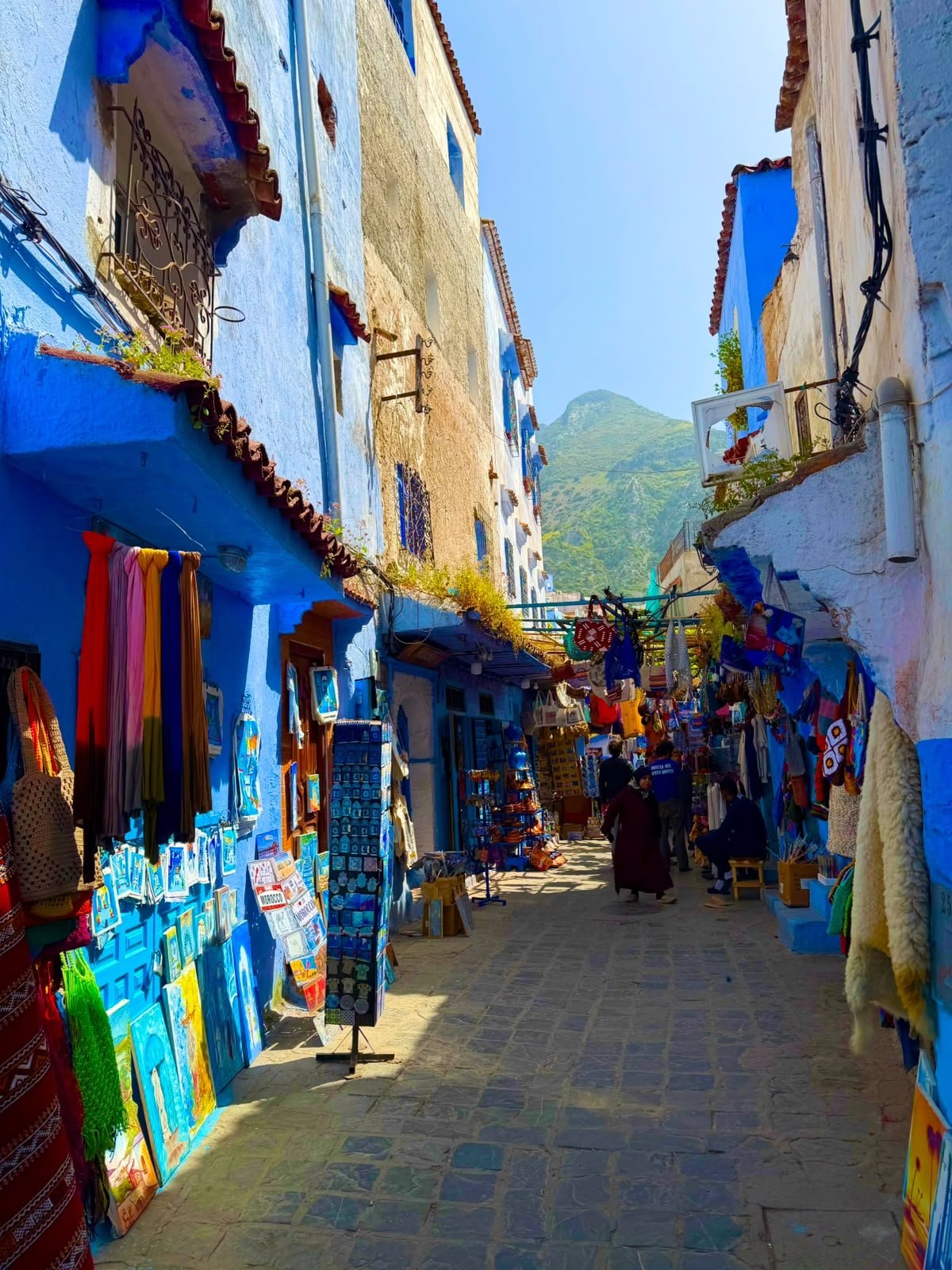
If you search for the Morocco blue city, the place you are looking for is Chefchaouen. Set against the Rif Mountains in northern Morocco, this small city is famous for a Medina filled with blue stairways, doors, walls and narrow lanes.
But the blue city of Morocco is more than a place for photographs. Chefchaouen has a historic Kasbah, traditional souks, mountain food, local crafts, viewpoints and access to some of northern Morocco’s most impressive natural landscapes.
One question appears again and again: why is Chefchaouen blue? The interesting answer is that there is no single explanation accepted by everyone. History, local traditions and the city’s modern identity have all contributed to the blue streets visitors see today.
This guide explains where the blue city in Morocco is, the main theories behind its color and the best things to do in Chefchaouen, including the Medina, Chefchaouen souk, local food, Ras El Ma and trips toward Akchour.
Morocco Blue City: Chefchaouen at a Glance
| Question | Quick answer |
|---|---|
| What is Morocco’s blue city? | Chefchaouen |
| Where is Chefchaouen? | Northern Morocco, in the Rif Mountains |
| Why is it famous? | Blue-painted Medina, mountain setting and traditional architecture |
| How long should you stay? | 1–2 nights is comfortable for most visitors |
| Closest popular cities | Tetouan, Tangier and Fes |
| Good nearby nature trip | Akchour and Talassemtane National Park |
| Best for | Photography, walking, crafts, food and mountain scenery |
Where Is the Blue City in Morocco?
If you are asking where is the blue city in Morocco, Chefchaouen is in the northwestern part of the country, surrounded by the Rif Mountains.
It is much closer to cities such as Tetouan and Tangier than to Marrakech.
The Moroccan National Tourist Office gives approximate road distances of 64.9 km from Tetouan, 112.4 km from Tangier and 194 km from Fes.
This location gives Chefchaouen a very different atmosphere from Marrakech or Casablanca. The streets climb and descend along the mountain slopes, and green peaks often appear behind the blue houses.
Is the Blue City in Marrakech?
No. This is a common source of confusion in online searches.
Chefchaouen is not in Marrakech. Marrakech is in central Morocco, while Chefchaouen is far to the north in the Rif Mountains.
If you search for “blue city Marrakech,” you are probably looking for Chefchaouen.
Traveling from Marrakech to Chefchaouen is a long journey and is not a practical day trip. If you want to combine the two cities, plan Chefchaouen as part of a longer Morocco itinerary and spend at least one night there.
Why Is Chefchaouen Blue?
The blue walls are the reason Chefchaouen the blue city has become internationally famous, but their origin is more complicated than many travel articles suggest.
There is no single historical explanation that has been conclusively proven.
Several theories are commonly discussed.
The Jewish heritage explanation
One of the best-known theories connects the blue color with Jewish communities that lived in Chefchaouen.
Blue has spiritual associations in Jewish tradition and is sometimes explained as a reminder of the sky, heaven and the divine.
Some accounts connect the wider use of blue in Chefchaouen particularly with Jewish residents during the twentieth century.
Blue as a symbol of coolness and water
Another local explanation is much more practical. Blue creates a visual sense of freshness in a mountain town that becomes hot during part of the year.
You may also hear the claim that blue helps discourage mosquitoes. This is a popular local explanation, but it should be treated as tradition rather than a scientifically established reason for painting an entire city.
Tourism and modern identity
The blue color gradually became one of Chefchaouen’s strongest visual identities.
Whatever the original reason, maintaining the different shades of blue is now closely connected with how residents, visitors and tourism businesses recognize the city.
The safest answer to why Chefchaouen is blue is therefore that several historical traditions and later practices probably contributed to the appearance seen today.
A Short History of Chefchaouen
Chefchaouen has far more history than its Instagram-famous streets suggest.
The city was founded in 1471 during a period of conflict and political change in northern Morocco. Its mountain location gave it strategic importance, and the historic Kasbah remains one of the clearest reminders of those defensive origins.
The city later received people arriving from Al-Andalus, helping create the architectural and cultural mixture still visible in northern Morocco.
Morocco’s Ministry of Culture lists the Kasbah of Chefchaouen as a nationally protected historical site, with legal classification dating from 1997. The city’s Grand Mosque also appears in the national heritage records.
10 Best Things to Do in Chefchaouen Morocco
The blue streets receive most of the attention, but there are enough things to do in Chefchaouen to justify staying longer than a quick photo stop.
| Experience | Time | Why do it? |
|---|---|---|
| Explore the blue Medina | 2–3 hours | Architecture and photography |
| Visit the Kasbah | 1 hour | History and gardens |
| Relax in Outa el-Hammam | 30–60 min | Main square and cafés |
| Walk to Ras El Ma | 30–60 min | Spring and local atmosphere |
| Visit a viewpoint | 1–2 hours | Panoramic city views |
| Shop in the souk | 1–2 hours | Textiles and crafts |
| Try local food | 1–2 hours | Northern Moroccan flavors |
| Explore local crafts | 1 hour | Weaving, wool and woodwork |
| Visit Akchour | Half/full day | Mountains and waterfalls |
| Enjoy sunset | 1 hour | Photography and views |
1. Walk Through the Blue Medina
The best introduction to Morocco the blue city is simply to walk.
Chefchaouen’s Medina is smaller than the old cities of Fes and Marrakech, which makes it easier to explore without following a strict itinerary.
You will find pale blue walls, deep indigo doors, staircases, small fountains, flowerpots and narrow streets climbing through the hillside.
Do not concentrate only on the famous photo locations. Some of the most pleasant streets are quieter residential lanes away from the busiest shopping routes.
Remember that people live here. Avoid blocking doorways and ask before photographing residents at close range.
2. Visit the Kasbah of Chefchaouen
The ochre-colored Kasbah creates a strong contrast with the surrounding blue Medina.
It stands beside the main square and helps explain why Chefchaouen was established in this strategic mountain location.
Inside, visitors can explore gardens and museum spaces connected with the history and culture of the area.
The Moroccan Ministry of Culture recognizes the Kasbah as a protected national heritage monument, making it much more than a decorative background for photographs.
3. Spend Time in Place Outa el-Hammam
Outa el-Hammam is the main social square of the Medina.
It is surrounded by cafés, restaurants and important historic buildings, including the Kasbah and Grand Mosque.
The square is particularly pleasant when you want to stop walking and watch daily life around you.
Have a mint tea, eat lunch on a terrace or return in the evening when the atmosphere becomes livelier.
4. Walk to Ras El Ma
Ras El Ma is located near the edge of the old town where mountain water reaches the city.
The walk is easy to combine with a longer exploration of the Medina and provides a change from the main shopping streets.
The Moroccan tourism office lists Ras El Ma among the essential places to experience in Chefchaouen.
Continue uphill from this part of town if you want wider views across the blue houses.
5. See Chefchaouen From Above
Chefchaouen is beautiful at street level, but the mountain setting becomes much clearer from above.
Several paths and viewpoints overlook the Medina. A popular walk climbs toward the hill opposite the town, where you can see the blue houses surrounded by the Rif Mountains.
Late afternoon is ideal if you want softer light and sunset photographs.
Wear shoes with reasonable grip because the streets and paths can be steep.
6. Explore the Chefchaouen Souk
The Chefchaouen souk is smaller than the markets of Marrakech or Fes, but that is part of its appeal.
The city is known for regional crafts, especially wool, weaving, woodwork and textiles.
Inside and around the Medina you may find:
- Handwoven blankets and rugs.
- Wool clothing.
- Leather products.
- Wooden objects.
- Traditional hats and clothing.
- Spices and food products.
- Handmade decorations.
The Moroccan National Tourist Office specifically highlights weaving, carpentry, wool and tanning traditions in Chefchaouen.
As elsewhere in Morocco, bargaining can be part of shopping. Keep it friendly and negotiate only when you have a real interest in buying.
7. Try Chefchaouen Food
Chefchaouen food reflects both Moroccan cooking and the agricultural traditions of the surrounding Rif region.
The city is also culturally significant in international food heritage. Chefchaouen is one of the Moroccan communities associated with the Mediterranean diet recognized by UNESCO as Intangible Cultural Heritage.
UNESCO explains that this tradition goes beyond individual dishes. It includes agriculture, preparation methods, shared meals, local knowledge and the social traditions connected with food.
| Food | What to expect |
|---|---|
| Fresh bread | A daily staple often served with meals |
| Tagine | Slow-cooked meat or vegetables with Moroccan spices |
| Couscous | Traditional semolina dish with vegetables and meat depending on preparation |
| Jben | Fresh cheese strongly associated with the Rif region |
| Olives and olive oil | Important parts of northern Moroccan food culture |
| Mint tea | Served throughout cafés and restaurants |
For a more local meal, walk a little away from the busiest terrace restaurants on the main square and look at menus in smaller streets.
8. Look for Traditional Chefchaouen Crafts
Shopping in Chefchaouen is not only about souvenirs.
The city’s craft traditions include woodwork, wool production, weaving and leather work. Watching a craftsperson at work can be more interesting than simply browsing finished products.
Textiles are particularly noticeable. The colors and patterns can differ from products commonly sold in Marrakech, reflecting the traditions of northern Morocco and the Rif.
9. Take a Trip to Akchour and Talassemtane
If you have more than one day, combine the Morocco blue town with the landscapes surrounding it.
Akchour is known for mountain trails, water and natural scenery, while Talassemtane National Park protects an important mountainous environment around Chefchaouen.
The Moroccan National Tourist Office identifies both Akchour Waterfalls and Talassemtane National Park among the main attractions around Chefchaouen.
Conditions can change after rain and during different seasons, so choose suitable shoes and check local conditions before longer hikes.
10. Watch Sunset Over the Blue City
Late afternoon is one of the best times to appreciate the blue city Morocco landscape.
The blue walls change color as direct sunlight disappears and the mountains around the city become more visible.
You can choose a terrace inside the Medina or walk toward a higher viewpoint outside the old streets.
If you enjoy photography, stay until the lights begin appearing across the town rather than leaving immediately after sunset.
Chefchaouen Food and the Mediterranean Diet
Food deserves more time than a quick restaurant stop.
Chefchaouen has an important connection with the Mediterranean food traditions of northern Morocco. UNESCO identifies Chefchaouen as one of the emblematic communities connected with the Mediterranean Diet heritage.
This heritage includes more than recipes. It covers farming, food preparation, seasonal products, shared meals and knowledge transmitted between generations.
That makes eating in Chefchaouen another way to understand the relationship between the town and its surrounding landscape.
How Many Days Do You Need in Chefchaouen?
| Stay | What you can do |
|---|---|
| Half day | Quick Medina walk, Outa el-Hammam and photos |
| 1 full day | Medina, Kasbah, souk, Ras El Ma and sunset |
| 2 days | Explore slowly and add food, crafts and viewpoints |
| 3 days | Add Akchour or hiking in the surrounding mountains |
For most first-time travelers, one or two nights provides a good balance.
A day trip allows you to see the main blue streets, but staying overnight gives you quieter hours in the Medina before day visitors arrive and after they leave.
Getting to Chefchaouen
Chefchaouen does not have the same direct rail access as Morocco’s largest cities, so most travelers arrive by road.
| Starting point | Approximate distance | Practical note |
|---|---|---|
| Tetouan | About 65 km | One of the closest major cities |
| Tangier | About 112 km | Convenient for northern Morocco itineraries |
| Fes | About 194 km | Popular connection with northern itineraries |
| Marrakech | Long-distance journey | Plan an overnight stay rather than a day trip |
Blue City Morocco From Marrakech: Is It Worth the Trip?
The keyword blue city Morocco from Marrakech is popular because many visitors want to combine Morocco’s two very different cities.
It is possible, but do not treat Chefchaouen as a normal excursion from Marrakech.
The two cities are far apart. A better itinerary is to travel north as part of a multi-city route, perhaps combining Marrakech with Fes and then Chefchaouen.
This gives you enough time to experience the city instead of spending most of the day inside a vehicle.
Best Time to Visit Chefchaouen
Spring and autumn are comfortable choices for travelers who want to combine city walking with the surrounding mountains.
Summer can be warm and busy, while winter brings cooler temperatures and more variable mountain weather.
Whatever the season, comfortable walking shoes are important. Chefchaouen is built on slopes, so you will encounter stairs and steep streets throughout the Medina.
Practical Tips for Visiting Morocco’s Blue City
- Wear comfortable shoes because Chefchaouen has many steep streets and stairs.
- Stay overnight if you want to experience quieter early mornings and evenings.
- Carry some Moroccan dirhams for small shops and cafés.
- Ask before photographing residents.
- Do not block private doors or narrow streets for photographs.
- Leave room in your schedule to explore without following a fixed route.
- Check weather and trail conditions before going to Akchour.
Frequently Asked Questions About Chefchaouen
What is the blue city of Morocco?
The blue city of Morocco is Chefchaouen, a mountain town in northern Morocco known for the blue-painted streets and houses of its historic Medina.
Where is the blue city in Morocco?
Chefchaouen is located in northern Morocco in the Rif Mountains, relatively close to Tetouan and Tangier.
Why is Chefchaouen blue?
There is no single proven explanation. Theories include Jewish cultural traditions, local ideas about coolness and insects, and the gradual development of blue as an important part of the city’s modern identity.
What are the best things to do in Chefchaouen?
Walk through the blue Medina, visit the Kasbah, relax in Outa el-Hammam, visit Ras El Ma, explore the Chefchaouen souk, try local food and take a trip toward Akchour if you have enough time.
Is Chefchaouen close to Marrakech?
No. Chefchaouen is in northern Morocco while Marrakech is much farther south. It is better to connect them as part of a longer Morocco itinerary rather than attempting a day trip.
Is Chefchaouen worth staying overnight?
Yes. Staying one or two nights gives you more time for the Medina, food, local crafts and viewpoints, and lets you enjoy the old town when there are fewer day visitors.
Final Thoughts on Morocco’s Blue City
Chefchaouen deserves its reputation as the famous Morocco blue city, but visiting only for the color means missing much of what makes the town interesting.
Behind the blue walls are more than five centuries of history, a protected Kasbah, regional crafts, mountain landscapes and food traditions connected with the wider Mediterranean culture of northern Morocco.
If you are deciding what to do in Chefchaouen, give yourself time to walk without rushing. Visit the historic sites, explore the Chefchaouen souk, eat local food and spend part of the day simply following the blue lanes uphill.
The photographs may be what first brings you to the blue city of Morocco, but the combination of history, food, mountain scenery and slower pace is often what makes visitors remember it.